
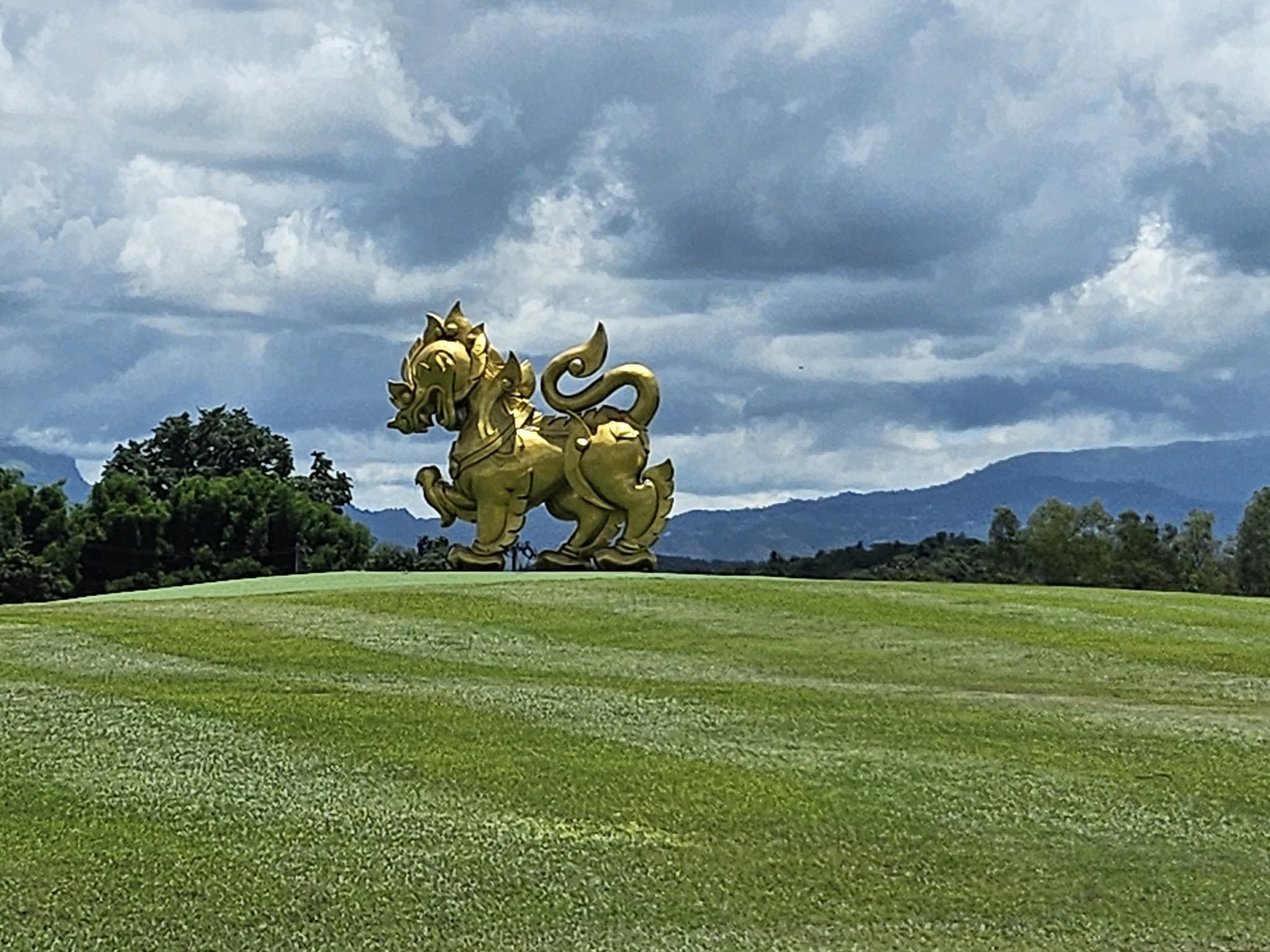

After exploring Chiang Rai’s famous White, Blue, and Black attractions and touring the Golden Triangle, we wanted to see another side of the region. Instead of visiting more of the area’s well-known temples, we headed into the countryside to discover three very different attractions: Singha Park, Wat Tham Pla, and the famous Tham Luang cave.
Together, they showed us just how much there is to discover beyond Chiang Rai’s most photographed landmarks.
Singha Park: Golf Carts, Swan Lake & Some Very Unusual Animals
Our first stop was Singha Park, a sprawling countryside attraction just outside Chiang Rai. Rather than trying to explore the enormous property on foot or with the shuttle bus, we rented a golf cart and set off to see what we could find.
Having our own golf cart made the experience much more enjoyable. We could cruise through the park at our own pace, stopping whenever something caught our attention. The property is enormous, with rolling hills, gardens, lakes, tea plantations, agricultural areas, and plenty of open countryside to explore.
One of our favorite stops was Swan Lake. We spent some time hanging out beside the water, enjoying the peaceful surroundings and the mountain scenery. After spending so much time visiting temples and sightseeing, it was nice to simply slow down for a while.
Then we discovered that Singha Park had another surprise waiting for us – the animals.
We arrived at the animal area just in time for feeding, and one of the most unusual sights was a herd of Ankole-Watusi cattle. These enormous cattle are instantly recognizable by their spectacular horns, some of which can reach an astonishing size. Watching them crowd around during feeding time was quite a sight.
And the Ankole-Watusi weren’t alone. We also saw zebras, giraffes, and several other animals as we explored the area. Seeing these animals roaming around against the backdrop of the northern Thai countryside was certainly not what we expected when we arrived at a park associated with tea and agriculture.


The animal encounters turned out to be one of the highlights of our visit. We could have easily spent the day simply driving around the countryside, but the combination of wildlife, gardens, lakes, and mountain scenery made Singha Park feel much more like an adventure than a typical tourist attraction.
And having the golf cart meant we could enjoy it without wearing ourselves out. We drove from one part of the park to another, stopping for photographs, checking out the animals, and eventually returning to Swan Lake to relax.
Singha Park was a completely different experience from Chiang Rai’s famous temples. There were no ornate Buddhist buildings or elaborate sculptures – instead, we had wide-open spaces, beautiful scenery, wildlife, and the freedom to explore at our own pace.
It was exactly the kind of unexpected stop we enjoy discovering during our travels.
Wat Tham Pla — Fish Cave Temple
From Singha Park, we continued to Wat Tham Pla, better known as Fish Cave Temple.
This was one of those places where we weren’t quite sure what to expect, which made the visit even more interesting.
The temple is located at the base of a forested mountain and gets its name from the fish that inhabit the stream and pools around the cave. Large schools of fish gather in the clear water, and visitors can walk around the grounds observing them.
The setting is beautiful. Rather than being surrounded by buildings and city streets, the temple is tucked into a lush natural environment with towering trees, limestone cliffs, and jungle vegetation.
The cave itself adds another element of adventure to the visit. A staircase leads upward into the rocky landscape, and exploring the area gives the temple a much more natural and mysterious character than many of the ornate temples we’ve visited elsewhere in Thailand.
We also encountered plenty of monkeys around the temple grounds. They have become part of the experience here, but visitors need to remember that they are wild animals. Keeping food and belongings secure is definitely a good idea.
Wat Tham Pla turned out to be much more than simply another temple stop. The combination of Buddhist shrines, caves, fish, monkeys, and dense forest made it one of the more unusual attractions we visited around Chiang Rai.


Tham Luang — The Cave That Captured the World’s Attention
Our final stop took us to a place that became internationally famous in 2018: Tham Luang.
The Tham Luang cave system became the center of a dramatic international rescue operation after twelve young members of a Thai soccer team and their coach became trapped inside the cave during heavy rains.
The story captivated people around the world as rescuers from Thailand and numerous other countries came together in an extraordinary effort to bring the boys and their coach safely out of the cave.
Today, the Tham Luang area has become both a memorial to that remarkable rescue and a place where visitors can learn more about what happened.
Standing at the entrance to the cave, it is difficult not to think about the incredible challenges faced by the rescue teams. The cave extends deep into the mountain, and the narrow passages, underground waterways, and unpredictable weather made the rescue an extraordinarily dangerous undertaking.
We explored the area surrounding the cave and learned more about the rescue operation. Seeing the entrance in person made the story feel much more real than simply watching the events unfold on television or reading about them online.
The surrounding area is also beautiful, with forest-covered mountains rising around the cave. It was easy to understand why the location had been such a popular destination for local visitors even before the international attention brought by the rescue.


And Then There Was a Snake in the Toilet…
Of course, no adventure would be complete without something completely unexpected happening along the way.
While visiting Tham Luang, I needed to use the restroom. I paid the 5-baht entrance fee, walked inside, and headed for the urinal.
And that’s when I discovered I wasn’t alone.
Sitting inside the urinal was a Malaysian krait snake.
Yes, a snake.
I have no idea how it got there, and I’m certainly glad I noticed it before getting too comfortable. Needless to say, I backed away and found someone who could deal with our unexpected visitor.
Fortunately, nobody was hurt, but it certainly provided one of the strangest – and funniest – travel stories of our entire trip.
And naturally, I took a picture.
Because if you don’t have photographic evidence, did it really happen?
Backpack Benji’s travel rule: Always check the toilet before sitting down. Apparently, this applies to urinals in northern Thailand too.


A Different Side of Chiang Rai
What made this day particularly enjoyable was the variety.
Singha Park offered beautiful agricultural landscapes and mountain scenery. Wat Tham Pla combined Buddhist traditions with caves, forests, fish, and monkeys. Tham Luang provided a fascinating connection to one of the most extraordinary rescue stories in modern history.
None of these places resembles the spectacular temples that have made Chiang Rai famous, and that’s exactly why they were worth visiting.
Chiang Rai is often promoted through its White Temple, Blue Temple, and other architectural masterpieces, but there is a much broader story to the region. Venture outside the city and you’ll find tea plantations, national parks, caves, agricultural estates, mountain villages, and landscapes that are just as memorable as the temples.
For us, discovering these lesser-known attractions was a reminder that sometimes the best travel experiences come from looking beyond the obvious.
Backpack Benji’s Best Bets
- Allow several hours for Singha Park if you want to explore beyond the main viewpoints and gardens.
- Rent a golf cart at Singha Park. The shuttle is on a strict schedule, and you’ll end up waiting around.
- Wear comfortable shoes at Wat Tham Pla because the temple grounds include stairs and uneven paths around the cave. It is a big hike up many jungle steps so take water with you.
- Be careful around the monkeys at Wat Tham Pla. Don’t feed them or leave food exposed.
- Give yourself time at Tham Luang to learn about the 2018 rescue rather than simply stopping for a photograph at the entrance.
- Check local conditions before planning a visit to the cave, as access can vary depending on weather and seasonal conditions.
- Consider renting a car or hiring a driver for these attractions. They are spread across the countryside and are much easier to combine by road.
Chiang Rai’s famous temples may be what first brings travelers to the region, but Singha Park, Wat Tham Pla, and Tham Luang showed us another side of northern Thailand—one filled with natural beauty, unusual attractions, fascinating history, and stories that stay with you long after you’ve left.