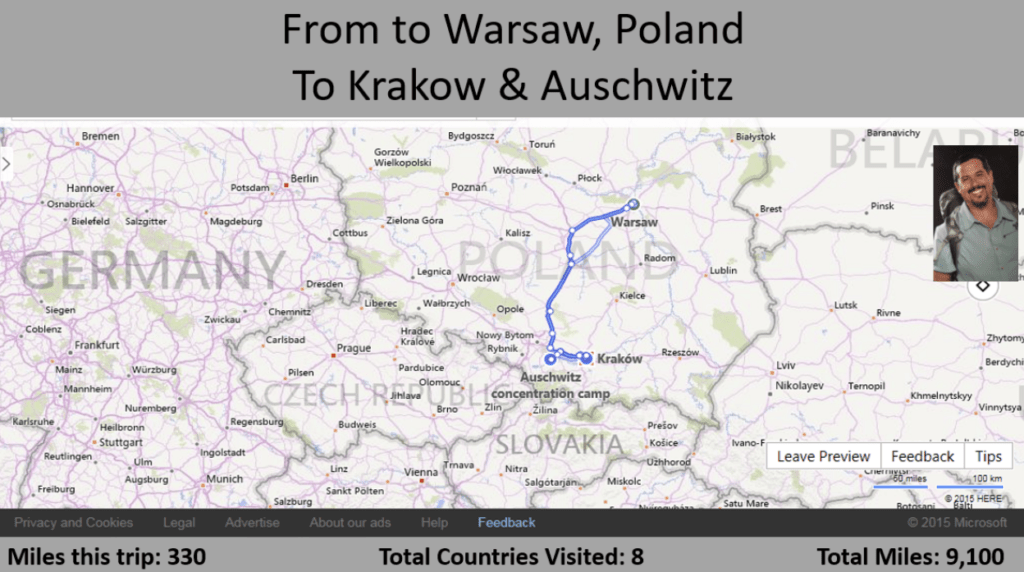
From Warsaw I traveled to Southern Poland. As the train slowed, I realized we were pulling into the same locomotive station depicted in the first scene of Steven Spielberg’s Schindler’s List film in Krakow.
I made my way to Old Town and checked into a historical hotel near the well-preserved medieval core of the ancient city.
Exploring Krakow’s Old Town
This city, a UNESCO World Heritage Site, is a true gem with a beautiful open market piazza (Glowny Square), Schindler’s Factory Museum, and the old ghetto in the Jewish quarter.
Once a Renaissance-era trading outpost, the town is home to St. Mary’s Basilica, a Gothic church from the 14th century, and bohemian cafes.
I strolled through the city, filled with cobblestone lane-ways and still surrounded by a portion of its medieval wall, with eclectic dining spots adding a touch of modern charm to this enchanting destination.


A Solemn Journey to Auschwitz
Leaving Krakow behind, I embarked on a solemn pilgrimage to Auschwitz and Birkenau, German Nazi Concentration and Extermination Camps from 1940–1945, and listed as UNESCO World Heritage Sites.
These sites, established by the Nazis during World War II, held immense historical significance and served as a reminder of humanity’s darkest chapter.
Established in 1940 by the Nazis, Auschwitz was an enormous labor camp and death factory. There were two main camps: the administrative center and the extermination camp. During the Holocaust, an estimated 1.1 to 1.6 million people were exterminated.
Remembering the Victims
As I walked through the gates of Auschwitz, a wave of somber reflection washed over me. The visit provided an opportunity to confront the depths of human cruelty and reflect on the unimaginable suffering endured by the Jewish people and countless others who fell victim to this horrific symbol of terror and genocide.
Exploring the grounds of Auschwitz was both terrifying and deeply moving. As I encountered the haunting remnants of the past, from prisoner barracks to gas chambers, a profound sense of sorrow and respect filled my heart.
The visit served as a poignant reminder of the importance of remembrance and ensuring that such atrocities are never repeated.


From Krakow’s Beauty to Auschwitz’s Darkness
My journey through Krakow, Auschwitz, and Birkenau provided a mirror into the human soul and served as a tool for self-reflection as I imagined what the Jewish people endured at this horrific symbol of terror, genocide, and the Holocaust.
From the captivating beauty of Krakow’s medieval streets to the somber reflection within the walls of Auschwitz, I gained a deeper understanding of history’s profound impact on our present.
Where I Stayed
Hotel Elektor Premium
In Kraków, I stayed at Hotel Elektor Premium, a small three-star hotel tucked into a historic tenement building in the heart of the Old Town. Its location was hard to beat—just a few steps from the famous Słowacki Theatre and only about a three-minute walk from Kraków’s Main Market Square. St. Florian’s Gate was also nearby, making it possible to step outside the hotel and immediately find myself surrounded by the history and energy of the city.
The location was especially convenient for a traveler like me. Kraków’s main railway station was only about a five-minute walk away, while Wawel Castle and the Kazimierz district were also within walking distance. There was little reason to worry about transportation when so much of the city could be explored simply by walking out the front door.
For me, Hotel Elektor Premium was less about luxury and more about location, character, and convenience. Staying in a historic building right in the middle of Kraków’s Old Town meant that the city was essentially my front yard. It was an excellent base for exploring Kraków and experiencing the atmosphere of one of Poland’s most fascinating cities.