

Leaving the dazzling lights of Bangkok behind, I pass through the Nonthaburi and Pathum Thani provinces and head north to Ayutthaya, the ancient capital of Siam and one of Thailand’s most fascinating UNESCO World Heritage Sites.
Trading skyscrapers for centuries-old temple ruins, I settle into a cozy riverside cottage, borrow an aging motorbike from the owner, and spend the next two days exploring a city that was once among the greatest in Asia.
The Rise of Ancient Ayutthaya
Founded in 1350, Ayutthaya served as the capital of the Kingdom of Siam for more than 400 years.
At its height, it was a thriving international trading center where merchants from China, Japan, Persia, Portugal, France, and the Netherlands exchanged goods, ideas, and culture.
Some historians estimate that more than one million people lived here during the 17th century, making Ayutthaya one of the world’s largest and wealthiest cities of its time.
That prosperity came to a devastating end in 1767 when the Burmese army invaded, burned the city, and destroyed many of its magnificent temples and palaces.
Rather than rebuild, the Siamese established a new capital farther south in Thonburi before eventually moving to Bangkok.
Today, the haunting ruins stand as a reminder of both the city’s incredible success and its tragic fall.
Exploring Ayutthaya by Motorbike
Exploring Ayutthaya by motorbike is one of the best ways to experience the historical park.
The roads are flat, traffic is light, and ancient temples seem to appear around every corner. Towering prangs (Khmer-style spires), weathered brick walls, and enormous Buddha statues—many draped in saffron robes—stand as silent witnesses to the city’s glorious past.
With an aging motorbike borrowed from the owner of my cottage, I had the freedom to wander wherever the road led me.
And in Ayutthaya, there always seemed to be something waiting around the next corner.
Wat Mahathat and the Buddha in the Tree
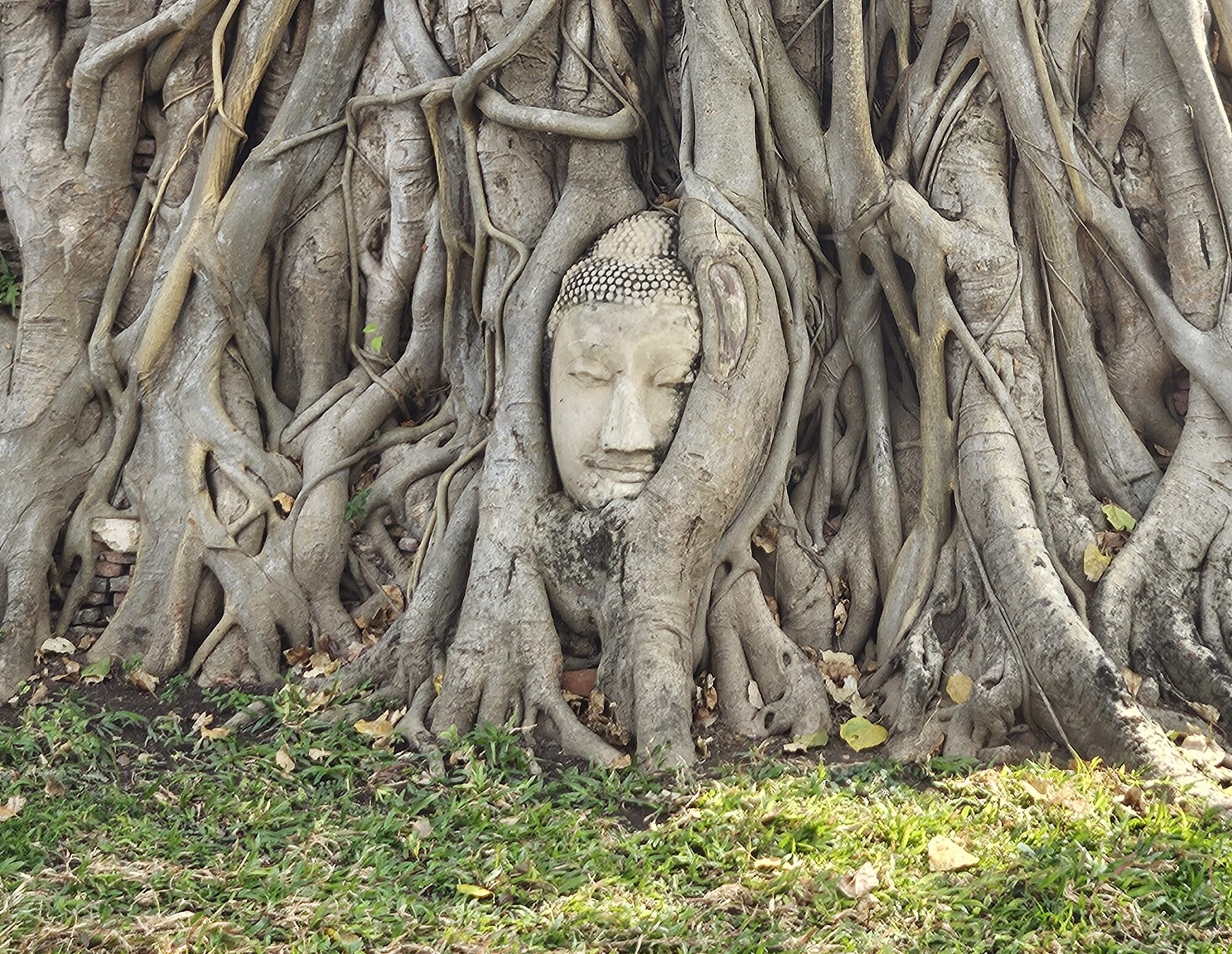
One of the highlights of my visit is Wat Mahathat, home to one of Thailand’s most photographed landmarks: the famous sandstone Buddha head nestled within the roots of a banyan tree.
No one knows exactly how it became entwined in the tree, but the peaceful expression on the Buddha’s face, framed by twisting roots, creates an unforgettable image.
Visitors are asked to kneel or remain lower than the Buddha’s head when taking photographs as a sign of respect.
It’s an extraordinary combination of nature, history, and spirituality—and one of those scenes that looks almost too perfect to be real.
The Royal Temple of Wat Phra Si Sanphet
Another unforgettable stop is Wat Phra Si Sanphet, once the royal temple of the Ayutthaya Kingdom.
Unlike most temples, monks did not live here. Instead, it served as the spiritual center of the royal palace complex.
Its three magnificent bell-shaped chedis, which contain the ashes of former kings, have become one of the defining symbols of Ayutthaya.
Ruins Around Every Corner
As I continue riding through the ancient capital, nearly every turn reveals another crumbling temple, weathered Buddha, or quiet archaeological site waiting to be explored.
Although much of the city lies in ruins, it’s easy to imagine the grandeur that once filled these streets centuries ago. There is something strangely peaceful about wandering through a place that was once one of Asia’s greatest cities. The absence of modern buildings within the historical area makes it even easier to imagine Ayutthaya as it once was.


An Unusual Way to See Ayutthaya
One of the more unusual ways to tour Ayutthaya is by elephant taxi.
While elephants have long been associated with Thailand’s history and royal traditions, many travelers today choose to admire them from a distance or visit ethical elephant sanctuaries instead.
Even simply seeing the elephants walking through the historic district adds another memorable dimension to the experience.
Ayutthaya at Sunset
As dusk approaches, I circle the island city one last time, watching the ancient temples glow beneath the fading light.
The rivers surrounding Ayutthaya reflect the silhouettes of centuries-old ruins, creating a peaceful atmosphere that feels worlds away from modern Bangkok.
It’s one of those moments when the history of a place seems to become more tangible.
After spending the day riding between ancient temples and crumbling ruins, watching the last light disappear over Ayutthaya provides a perfect ending to the day.


A Riverside Cottage
That evening, I return to my riverside cottage at The Old Palace Resort Klong Sa Bua ($25 USD per night).
The owner prepares a simple homemade dinner, and after a full day wandering through the remnants of an ancient kingdom, the gentle sounds of the river and distant temple bells make for a perfect ending.
There was something wonderfully fitting about spending the night beside the river after a day exploring the ruins of a city that had depended so heavily on its waterways.
Continuing the Journey
I arrived in Ayutthaya aboard a small passenger van from Bangkok and, after two unforgettable days exploring the ruins, continued my journey by train toward Nakhon Ratchasima (Korat).
Sometimes the best travel experiences aren’t found in bustling cities or famous beaches—they’re hidden among the echoes of civilizations long gone.
Ayutthaya was one of those places for me.
The ruins may tell the story of a kingdom that disappeared centuries ago, but riding through the ancient city, discovering temples around every corner, and watching the sunset over the old capital made the history feel surprisingly alive.
Backpack Benji’s Best Bets
- Spend at least one full day exploring the Historical Park—two days is even better if you enjoy history or photography.
- Rent a bicycle or motorbike to explore at your own pace. The ruins are spread out, and having your own transportation makes visiting much easier.
- Visit early in the morning or late in the afternoon to avoid the midday heat and capture the best lighting for photos.
- Dress respectfully, as many of the temples remain active places of worship.
- Don’t miss Wat Mahathat, Wat Phra Si Sanphet, and Wat Chaiwatthanaram, especially around sunset.
- If you’re traveling between Bangkok and northeastern Thailand, Ayutthaya makes an excellent overnight stop.